🌿 Curly Parsley
About Curly Parsley
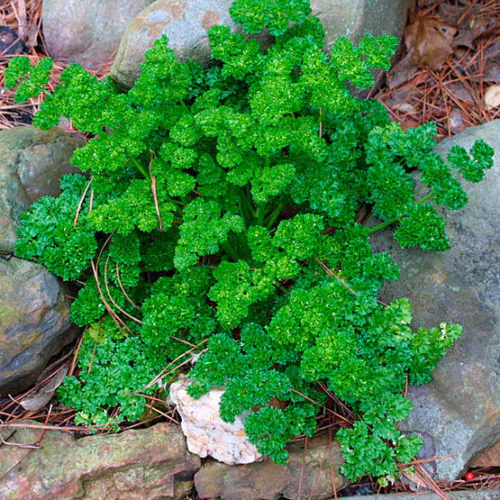
Curly parsley is the crisp, ruffled-leaf form of garden parsley (Petroselinum crispum), a hardy biennial in the carrot family (Apiaceae) widely grown as an annual for its aromatic foliage. It forms a low rosette of finely divided, tightly curled, bright green leaves on slender petioles, with a mild, fresh flavour and a clean, slightly peppery aroma. Plants typically reach 20–30 cm tall in leaf, and in their second year produce upright flowering stems bearing flat-topped umbels of small yellow‑green flowers, followed by ribbed seeds. Parsley is native to the Mediterranean region and has long been cultivated in Europe and elsewhere as both a culinary herb and a traditional garden plant. Curly parsley is valued for garnishing and for adding herbal brightness to soups, sauces, egg dishes, and vegetable preparations; it is generally milder than flat-leaf parsley. It grows best in full sun to light shade in fertile, evenly moist, well-drained soil, and benefits from regular harvesting to encourage new growth. Seeds can be slow to germinate and seedlings prefer steady moisture. In warm weather or under stress, plants may bolt, becoming more fibrous and less productive. Like other parsley types, it is a notable dietary source of vitamin K and also provides vitamin C and provitamin A carotenoids.
🌱 Detailed Care Guide
📐 Growth & Structure
📅 Phenology
🌍 Ecology
✨ Usage & Benefits
- edible
- ornamental
- aromatic
- medicinal
- spice
- Edible parts: leaf, stem
⚠️ Safety & Traits
🌱 Propagation
🧪 Soil & Nutrition
🐛 Pests & Diseases
📝 Expert Advice
Grow in fertile, moisture-retentive but well-drained soil rich in organic matter (e.g., loam improved with compost). Avoid waterlogged or compacted ground; aim for an open, friable structure that holds moisture yet drains freely. A near-neutral pH is ideal (about pH 6.0–7.0; tolerates slightly alkaline). For containers, use a high-quality potting mix amended with compost and a drainage aid (e.g., perlite/grit) to keep roots aerated while maintaining even moisture.
Sow curly parsley (Petroselinum crispum) from seed; it is slow and often erratic to germinate. When to sow: - Outdoors: sow from early spring once soil is workable through late summer for autumn crops (timing depends on local frost dates). - Indoors: start 6–8 weeks before last frost for earlier plants; harden off before planting out. How to sow: - Site/medium: fertile, moisture-retentive, well-drained soil or a quality seed-starting mix; full sun to partial shade. - Pre-soak: soak seed 12–24 hours in water (optional) to help speed germination. - Sowing depth: 5–10 mm (about 1/4–3/8 in); cover lightly. - Spacing: sow thinly in rows; after emergence thin to 15–25 cm (6–10 in) between plants; leave 30–45 cm (12–18 in) between rows. - Containers: sow a few seeds per cell/pot, thin to 1 strong seedling; transplant carefully to avoid disturbing roots. Germination: - Keep evenly moist (not waterlogged); avoid letting the surface dry out. - Typical soil temperature: about 15–21°C (59–70°F). - Germination time: commonly 2–4+ weeks. Planting out/transplanting: - Transplant when seedlings have several true leaves and after hardening off. - Plant at the same depth as in the pot; water in well. Succession: - Make small sowings every 3–4 weeks in the growing season for a continuous supply. - In mild climates, an autumn sowing can overwinter for early spring growth.
Parsley is a light-to-moderate feeder. Before planting, incorporate compost or well-rotted manure into the bed; if soil is poor, mix in a modest amount of a balanced fertilizer (e.g., 5-5-5 or 10-10-10) according to label rates. After plants are established, side-dress lightly with compost or a small amount of balanced fertilizer about every 4–6 weeks during active growth, especially after repeated harvests. Avoid heavy nitrogen feeding (high-N lawn fertilizers), which can promote lush growth with weaker flavor and softer stems. In containers, use a diluted balanced liquid fertilizer or fish/seaweed feed about every 2–4 weeks, and reduce feeding in cool/low-light periods or if growth is slow.
Mulch parsley with a thin (2–5 cm) layer of organic material such as compost, leaf mould, or finely shredded straw to conserve soil moisture and suppress weeds. Keep mulch a few centimetres away from the crown/stems to reduce the risk of rot and slug damage. Refresh as it breaks down; in cold winters, a slightly thicker mulch can help protect plants, but reduce or pull back mulch in persistently wet conditions.
Curly parsley (Petroselinum crispum) is used in traditional herbal medicine primarily as a mild diuretic to increase urine output and support “urinary tract flushing” for minor urinary complaints. It has also been used as a digestive/carminative (to ease indigestion and gas). The leaves provide bioactive flavonoids (e.g., apigenin) and vitamins (notably vitamin C and vitamin K) with antioxidant activity; laboratory studies support antioxidant and antimicrobial effects, though robust clinical evidence for specific therapeutic outcomes is limited.
📋 Additional Information
📖 View Complete Guide
For the full interactive experience with additional photos, personalized advice, and gardening tools:
Visit Aphylia →