🧗 Humulus lupulus
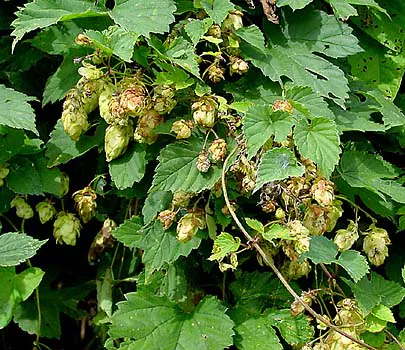
About Humulus lupulus
Humulus lupulus, common hop, is a vigorous, herbaceous perennial climber in the Cannabaceae. It grows from a long-lived crown with spreading rhizomes and produces annual twining stems (bines) that can extend several metres in a season, climbing by clockwise twining around supports. The leaves are opposite, rough-textured, and typically three- to five-lobed with serrated margins. Plants are usually dioecious, bearing male and female flowers on separate individuals; cultivated hop gardens generally grow female plants for their cone-like infructescences (strobiles). These “hop cones” contain glandular trichomes that produce lupulin, rich in bitter acids and aromatic essential oils valued for flavouring, preserving, and stabilising beer. The species is native across temperate regions of Europe and western Asia and is widely naturalised elsewhere, often occurring along hedgerows, woodland margins, and riparian corridors where soils are moist and fertile. In cultivation it performs best in full sun with ample water and nutrients, and it is commonly trained onto trellises to improve air movement and cone quality. As a strongly rhizomatous plant, it can spread beyond intended areas if not managed. Hop plants also provide habitat and nectar resources, while their foliage and cones can be affected by fungal diseases such as downy mildew and powdery mildew under humid conditions.
🌱 Detailed Care Guide
📐 Growth & Structure
📅 Phenology
🌍 Ecology
✨ Usage & Benefits
- edible
- ornamental
- aromatic
- medicinal
- spice
- infusion
- Edible parts: stem, leaf, flower
⚠️ Safety & Traits
🌱 Propagation
🧪 Soil & Nutrition
🐛 Pests & Diseases
📝 Expert Advice
Grow in deep, fertile, humus-rich soil that retains moisture yet drains freely (e.g., well-drained loam). Incorporate plenty of organic matter/compost to improve structure and water-holding. Avoid waterlogged sites and very heavy clay unless well amended, and avoid very dry, poor sands. Best performance is in slightly acidic to neutral soil (about pH 6.0–7.5).
Humulus lupulus (hop) is most reliably established by planting dormant rhizomes or rooted cuttings in spring; seed-raised plants are variable and may be male or female. From seed: - Use fresh seed if possible. Cold-stratify (moist, in a sealed bag) for about 4–8 weeks at ~1–5°C to break dormancy. - Sow in late winter/early spring in trays or pots of free-draining seed compost; cover lightly (about 3–5 mm) and keep evenly moist. - Maintain warm conditions (around 15–20°C) and good light; germination can be slow and irregular. - Prick out and pot on when seedlings have true leaves; harden off. - Plant out after the last frost into a sunny, sheltered site. Planting/rhizomes (preferred): - Plant in spring when soil is workable. Set rhizomes 5–10 cm deep with buds upward; water in well. - Choose deep, fertile, moisture-retentive but well-drained soil; incorporate compost/manure. - Provide strong vertical supports/trellis (hops are vigorous climbers). - Space plants about 1–2 m apart (wider if growing multiple crowns) and keep weed-free; mulch to conserve moisture. - Train young bines onto strings/wires once they are 30–60 cm tall and protect new growth from late frosts.
Base fertility on a soil test; hops are vigorous, high‑biomass perennials and typically need the most nitrogen (N) during spring–early summer, with adequate phosphorus (P) and potassium (K) to support root health and cone yield/quality. • Before planting or in early spring (yearly): Incorporate well‑rotted compost/manure as needed and correct pH/nutrients per soil test. Apply P and K (and micronutrients such as boron if deficient) mainly as preplant/early‑season amendments because they move slowly in soil. • Nitrogen timing (established plants): Apply most N from shoot emergence through bine training and rapid vegetative growth; split applications are preferred (e.g., at emergence and again 3–5 weeks later) to reduce leaching and excessive late growth. • Avoid late N: Minimize or stop N applications by early–mid summer (before burr/cone development, depending on climate) to reduce excessive vegetative growth, increased disease pressure, delayed maturity, and reduced cone quality. • Method: Band or side‑dress granular fertilizer along the row (not directly on crowns) or fertigate in small doses if irrigated. Water in after application. • Typical targets (guideline ranges): Many production guides commonly target moderate to high seasonal N inputs, adjusted for soil organic matter, prior crop, irrigation, and expected yield; use local extension recommendations for your region and cultivar. • Young plantings: Use lighter N rates in the first year to favor root/crown establishment; avoid high salts near young plants. • Monitoring: Watch for overly dark, lush growth (excess N) or pale leaves/poor vigor (insufficient N). Annual soil tests (and, where practiced, in‑season tissue tests) help fine‑tune rates.
Apply an organic mulch (garden compost, well-rotted manure, leaf mould, straw, or shredded bark) in spring after the soil has warmed to conserve moisture and suppress weeds. Keep mulch a few centimetres back from the crown/shoots to reduce the risk of crown rot and slug damage. Maintain a 5–8 cm (2–3 in) layer through the growing season, topping up as it breaks down. In colder climates, after autumn dieback, a thicker winter mulch around (not over) the crown can help protect against freeze–thaw; pull it back in early spring as new shoots emerge.
Provide a very strong vertical support system: hops are vigorous climbing bines and can reach several metres in a season. Use tall poles or a wall/trellis with a high horizontal wire (often 3–6 m in gardens; higher in production) and run durable twine/rope (e.g., coir or heavy garden twine) from the top wire down to the crown, securely pegged or tied at the base. When shoots are 30–60 cm long, select the strongest 2–3 bines per string and train them by gently wrapping them clockwise around the twine; remove excess shoots to reduce tangling. Continue guiding new growth onto the support until it self-twines; avoid tight ties that could constrict the bines, and ensure the structure is well anchored to withstand wind and the weight of mature growth.
Humulus lupulus (hops) female inflorescences (strobiles) are used in herbal medicine primarily as a mild sedative and sleep aid, including for short‑term relief of mild symptoms of mental stress and to aid sleep (often alone or combined with valerian). As a bitter aromatic drug it has also been used traditionally to support digestion and appetite. Constituents such as prenylated flavonoids (e.g., 8‑prenylnaringenin) show estrogenic activity in pharmacological studies, and hop preparations have been investigated/used for relief of mild menopausal symptoms; clinical evidence is limited compared with its use for sleep/stress.
Hop (Humulus lupulus) strobile infusions are traditionally used as a mild sedative to help relieve mild symptoms of mental stress and to aid sleep (e.g., nervous restlessness and difficulty falling asleep). As a bitter herb, hop tea has also been used traditionally to support digestion, including temporary loss of appetite and mild dyspeptic complaints (e.g., bloating/fullness). Clinical evidence for these benefits is limited; much of the use is based on traditional herbal medicine and pharmacopoeial monographs.
Humulus lupulus (hop) dies back to a perennial crown each winter; pruning is primarily cutting back old bines and regulating new shoots. • Late winter/early spring (before vigorous growth): Cut all old, dead bines from the previous season down to near ground level and remove them from the site. Clear debris around the crown to improve airflow and reduce carryover of pests/diseases. • Spring shoot selection (once new shoots are 15–30 cm/6–12 in long): Thin to the best 2–4 strong shoots (bines) per hill/crown (often fewer for smaller supports; more only if the structure and vigor allow). Remove weaker/excess shoots at the base. Train selected bines onto strings/supports by wrapping in the climbing direction. • Early season cleanup: Continue to remove new basal shoots that appear below the trained bines for several weeks to prevent overcrowding and improve air movement. • Summer management (optional depending on system): Remove lower leaves and laterals from the bottom 60–100 cm (2–3 ft) of the bines to improve airflow and reduce disease risk; avoid excessive stripping in hot/dry conditions. Lightly prune tangled laterals only as needed to maintain access and airflow. • After harvest/autumn: Cut bines back to the crown once they have browned or after harvest. Dispose of cut material; do not compost if disease is present. • General: Use clean, sharp tools; avoid injuring the crown. If rejuvenation is needed, more aggressive thinning in spring is preferred over retaining many weak bines.
📋 Additional Information
📖 View Complete Guide
For the full interactive experience with additional photos, personalized advice, and gardening tools:
Visit Aphylia →