🌱 Selaginella lepidophylla
About Selaginella lepidophylla
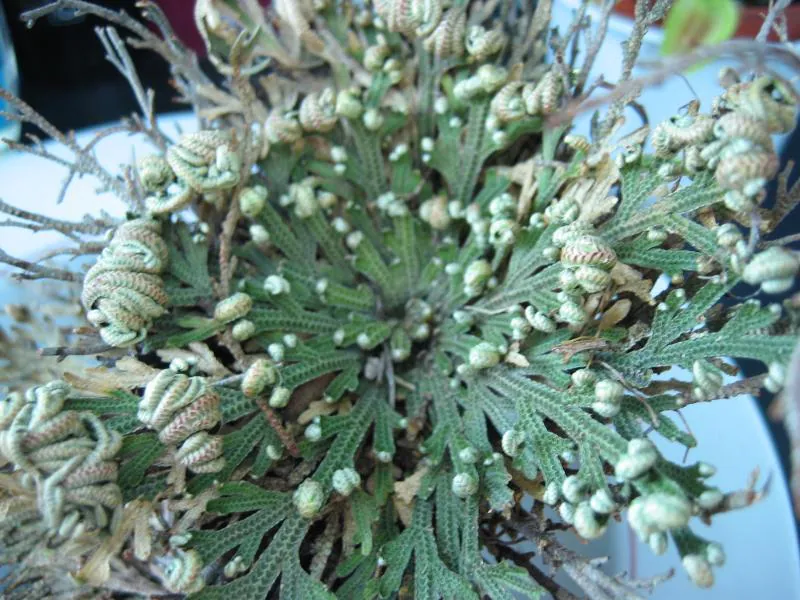
Selaginella lepidophylla is a desert lycophyte (spikemoss) in the family Selaginellaceae, native to arid regions of northern Mexico and the southwestern United States, especially the Chihuahuan Desert. It is widely known as the resurrection plant for its extreme desiccation tolerance. In dry conditions the stems curl inward into a tight ball, reducing surface exposure and helping protect tissues from heat and water loss; when moisture returns, the plant rapidly uncurls and resumes photosynthesis. This reversible drying and rehydration reflects a poikilohydric strategy in which internal water content tracks the environment, supported by physiological and structural adaptations that stabilize cells during dehydration. The plant forms low, mat-like rosettes with small, scale-like microphylls arranged along branching stems. Like other selaginellas it reproduces by spores rather than seeds, bearing sporangia in terminal strobili; it is heterosporous, producing separate megaspores and microspores. In nature it occupies rocky or sandy sites where rainfall is sporadic and humidity pulses are brief, allowing it to persist in a dormant, desiccated state for extended periods and to green quickly after wetting. Because of this dramatic response to water, it is frequently sold as a curiosity specimen, though its revival depends on the availability of viable living tissue and suitable rehydration conditions.
🌱 Detailed Care Guide
📐 Growth & Structure
📅 Phenology
🌍 Ecology
✨ Usage & Benefits
- ornamental
- medicinal
⚠️ Safety & Traits
🌱 Propagation
🧪 Soil & Nutrition
🐛 Pests & Diseases
📝 Expert Advice
Use a very free-draining, gritty/mineral substrate to prevent rot. A cactus/succulent-type mix amended with extra sand, grit, or perlite works well; keep it airy rather than rich. Avoid heavy, water-retentive soils and standing water—allow the plant to dry between rehydrations.
Selaginella lepidophylla is a spore-bearing lycophyte and is not normally grown from seed. Propagation from spores is possible but slow and difficult (requires very fresh spores, sterile conditions, constant warmth, high humidity, and low light), so it is generally not recommended for home growers. Planting/starting (typical method): - To “start” a dormant ball, set it on a shallow dish or tray on top of gravel/sand and add water so the base stays moist (do not submerge the whole plant). It will rehydrate and unfurl over 1–3 days. - For longer-term pot culture, plant shallowly on the surface of a very free-draining, gritty mix (e.g., cactus/succulent mix cut with coarse sand/perlite). Keep the medium lightly moist while actively growing; avoid waterlogging. - Light/temperature: bright, indirect light; warm conditions; protect from frost. - Moisture cycle: it tolerates complete drying and will curl up; if kept as a “resurrection” novelty, allow it to dry fully between rehydrations to reduce rot. If grown as a living plant, avoid repeated extreme dry–wet cycles and maintain more even (but not saturated) moisture.
Selaginella lepidophylla is adapted to very nutrient-poor conditions and generally needs little to no fertilizer. If grown long-term in a potting medium, feed only when the plant is actively green and hydrated: apply a balanced, water-soluble houseplant fertilizer at 1/4 strength about every 4–6 weeks in spring and summer. Avoid fertilizing when the plant is dry/curled (dormant) or in winter. Use low-salt formulations and flush the medium occasionally with plain water to prevent salt buildup, which can damage the roots.
Traditionally used in northern Mexico and the southwestern United States as an herbal tea (often sold as “resurrection plant” or “doradilla”) as a diuretic and for urinary/kidney complaints, including folk use for kidney stones and related discomfort. Laboratory studies of extracts report bioactive compounds with antioxidant and anti‑inflammatory activity, but there is limited clinical evidence to confirm efficacy or safety for medicinal use in humans.
📋 Additional Information
📖 View Complete Guide
For the full interactive experience with additional photos, personalized advice, and gardening tools:
Visit Aphylia →