🌳 Silver Wattle
About Silver Wattle
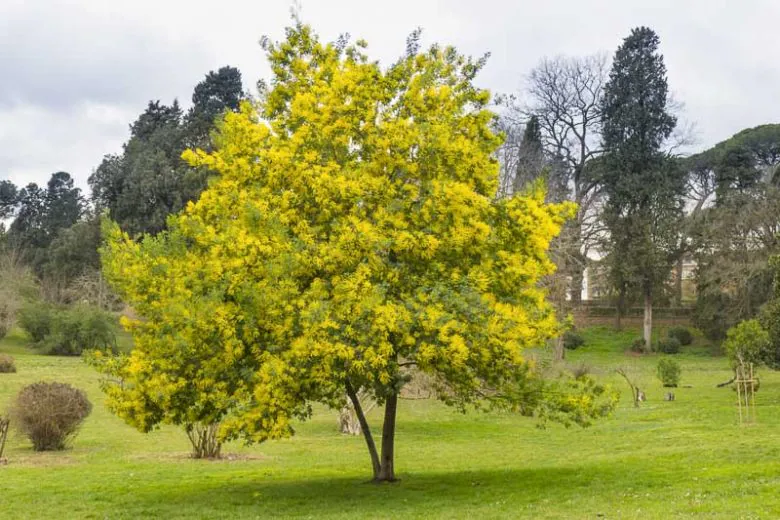
Silver wattle (Acacia dealbata) is a fast-growing evergreen tree of the pea family (Fabaceae, subfamily Mimosoideae), native to south‑eastern Australia, especially New South Wales, Victoria and Tasmania. It typically forms a small to medium tree with smooth grey bark and a spreading crown, valued for its distinctive, bluish-grey, finely divided bipinnate leaves that give the foliage a silvery appearance. In late winter to early spring it produces abundant, fragrant, bright yellow flower heads in clustered sprays; each “puffball” is composed of many tiny flowers rich in pollen and nectar. After flowering, flat, brown pods develop and release hard-coated seeds that can persist in soil and germinate after disturbance. Outside its native range, A. dealbata has been widely planted as an ornamental, a source of cut flowers (often sold as “mimosa”), and historically for tannin and shelter plantings. It readily colonizes disturbed sites, stream edges and open woodland, and is recognized as invasive in several regions with mild climates, including parts of the Mediterranean Basin, South Africa and the western United States. Its rapid growth and dense stands can alter light levels and native plant regeneration, making careful management important where it naturalizes.
🌱 Detailed Care Guide
📐 Growth & Structure
📅 Phenology
🌍 Ecology
✨ Usage & Benefits
- edible
- ornamental
- fragrant
- Edible parts: flower, seed
⚠️ Safety & Traits
🌱 Propagation
🧪 Soil & Nutrition
🐛 Pests & Diseases
📝 Expert Advice
Grow in a well-drained, airy soil (sandy or loamy) and avoid waterlogging; it performs best in light, moderately fertile ground but tolerates poor soils. Slightly acidic to neutral pH is suitable, and established plants cope with dry, free-draining sites better than heavy, wet clay.
Propagate Silver Wattle (Acacia dealbata) mainly from seed. Seeds have a hard coat and usually need pre-treatment: pour near‑boiling water over the seed (about 80–90°C), leave to cool and soak for 12–24 hours; discard any that remain hard and repeat if needed. Sow swollen seed in a free‑draining seed‑raising mix (e.g., sand/loam or propagation mix), 3–5 mm deep, and keep evenly moist but not waterlogged. Provide warmth and light (about 18–25°C); germination commonly occurs within 1–4 weeks after treatment. Prick out/pot on when seedlings are large enough to handle (after several true leaves), growing on in deep pots to accommodate the taproot. Harden off before planting out. Plant in a sunny position with well‑drained soil; water regularly until established, then only during prolonged dry periods. Protect young plants from hard frost and waterlogging.
Silver wattle (Acacia dealbata) is a nitrogen‑fixing legume and usually needs little or no fertiliser once established. In the ground: improve planting soil with organic matter (compost/leaf mould) rather than regular feeding; top‑dress with compost in spring if growth is weak. If fertilising, use a low‑phosphorus, slow‑release fertiliser formulated for Australian/native plants in spring (optionally again in early summer on very poor soils), and avoid heavy applications of high‑nitrogen or high‑phosphorus products which can cause soft growth and reduce flowering. In pots: use a controlled‑release native fertiliser at the label rate in spring, or liquid feed at half strength every 4–6 weeks during active growth; stop feeding in late autumn/winter. Always water in after application and do not fertilise drought‑stressed plants.
Apply a coarse organic mulch (e.g., wood chips or leaf litter) over the root zone to conserve moisture and suppress weeds, especially during establishment. Maintain a mulch layer about 5–8 cm deep and keep it pulled back several centimetres from the trunk to prevent collar rot and pest issues. Avoid piling mulch against the stem and do not mulch so heavily that drainage is impeded; Silver Wattle prefers well‑drained soils.
Prune Silver Wattle (Acacia dealbata) immediately after flowering (late winter to spring, depending on climate) to avoid removing next season’s flower buds. Aim for light to moderate pruning: remove dead, damaged or diseased wood, thin crowded/crossing shoots, and shorten this season’s long whippy growth to maintain shape and reduce wind damage. Avoid routine hard cutting into old, leafless wood, which can lead to poor regrowth or dieback; if renovation is necessary, do it right after flowering and reduce gradually over 1–2 seasons. Remove basal suckers and any unwanted seedlings, and consider removing spent flower heads/pods to limit self-seeding where the species is invasive. Use clean, sharp tools and make cuts back to a lateral branch or just above a node.
📋 Additional Information
📖 View Complete Guide
For the full interactive experience with additional photos, personalized advice, and gardening tools:
Visit Aphylia →