🌲 Goji berry
About Goji berry
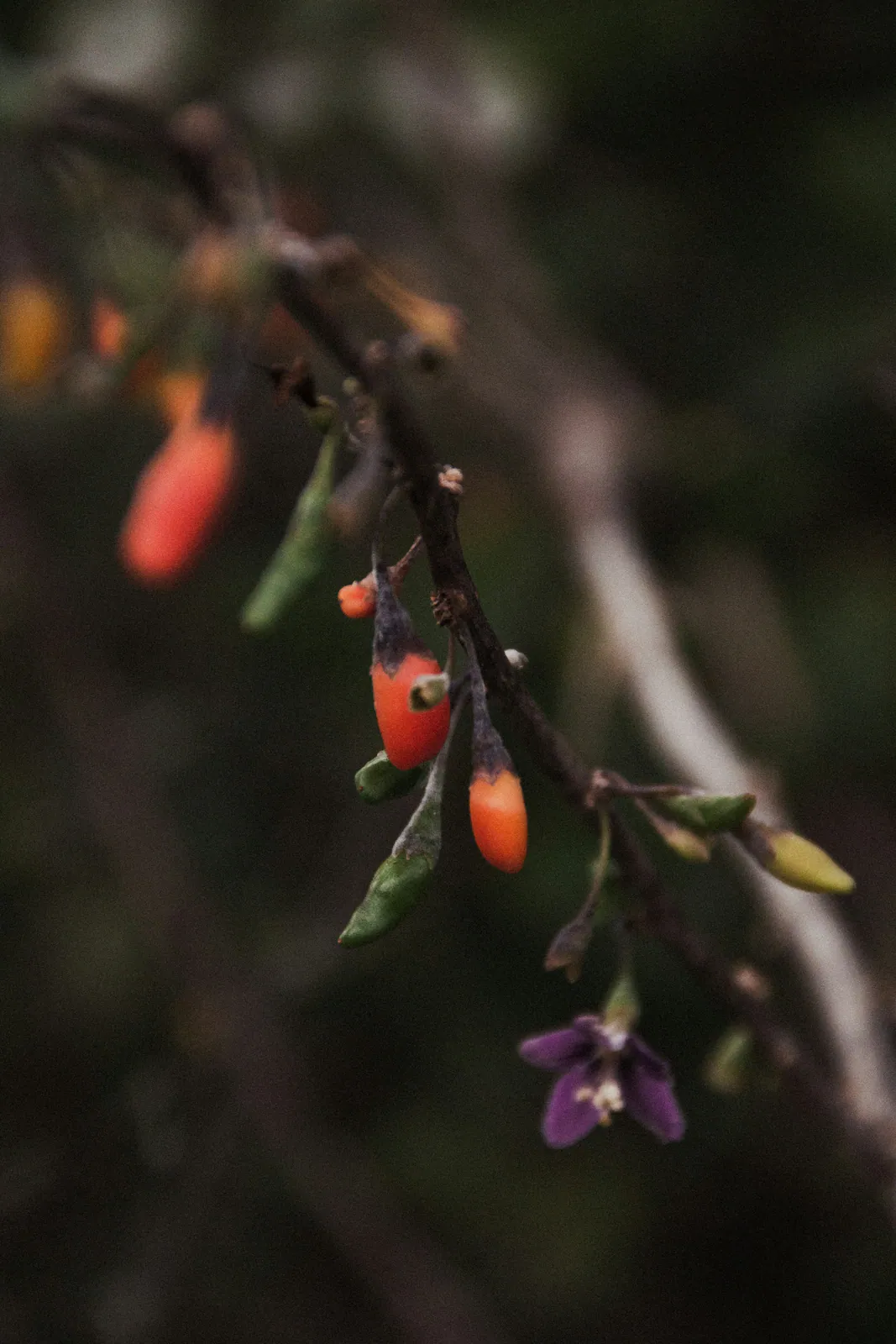
Goji berry refers chiefly to the fruits of Lycium barbarum and Lycium chinense (Solanaceae), deciduous shrubs long cultivated in northern and western China and across parts of temperate Asia. Plants typically form arching, thorny stems with narrow, lanceolate leaves borne alternately or in small clusters. In summer, they produce small, tubular to bell-shaped flowers, usually pale purple to violet, followed by bright orange‑red, ellipsoid berries containing many flattened seeds. Goji is adapted to full sun and well‑drained soils and is valued for tolerance of drought and a wide range of temperatures once established. In cultivation it is commonly trained on wires or pruned to maintain an open framework, encouraging flowering on current season’s growth. The berries are harvested when fully colored; they are traditionally dried and used in teas, soups, and tonic preparations, and are also consumed fresh where available. Nutritionally the fruits contain carotenoids (notably zeaxanthin), polysaccharides, and vitamin C, although composition varies with species, cultivar, and growing conditions. Like other members of the nightshade family, goji can host pests and diseases shared with related crops; careful sanitation and monitoring are important, particularly in humid climates.
🌱 Detailed Care Guide
📐 Growth & Structure
📅 Phenology
🌍 Ecology
✨ Usage & Benefits
- edible
- medicinal
- ornamental
- infusion
- Edible parts: leaf, fruit
⚠️ Safety & Traits
🌱 Propagation
🧪 Soil & Nutrition
🐛 Pests & Diseases
📝 Expert Advice
Grow in a well-drained, moderately fertile loam or sandy loam; the plant tolerates poor, dry soils but performs best where drainage is good. Avoid waterlogged or compacted substrates (use raised beds or amend heavy clay with coarse mineral material and organic matter to improve structure). A neutral to slightly alkaline soil reaction is suitable; incorporate compost for steady moisture retention without sogginess and maintain an organic mulch to moderate moisture and temperature.
Seed (indoors): Sow in late winter to spring (about 6–10 weeks before last frost). Use a sterile, free‑draining seed compost; sow on the surface and cover very lightly (seeds need only a thin covering). Keep evenly moist (not waterlogged) and warm (about 20–25°C) in bright light. Germination typically occurs in ~1–3 weeks. Prick out/ pot on once seedlings have true leaves and are large enough to handle; grow on in good light. Planting out: Harden off for 7–10 days, then plant outside after risk of frost has passed. Choose full sun (tolerates light shade) and well‑drained soil; avoid persistently waterlogged sites. Space plants about 1–1.5 m apart (more if training as a hedge); water in well and mulch. Provide support (stake or trellis) if training as a cane‑type shrub. Direct sowing (mild climates): Sow in spring after last frost into a prepared, fine seedbed; cover very lightly and keep consistently moist until established. Seedlings are slow initially; keep weed‑free. Transplants/bare‑root plants: Plant in spring (or autumn in mild regions) at the same depth as in the pot/nursery; firm in and water thoroughly.
Goji berry (Lycium spp.) is a light–moderate feeder; avoid heavy nitrogen fertilization, which promotes soft, vegetative growth at the expense of flowering/fruiting. - At planting / annually: Incorporate or top-dress with well-rotted compost (or other organic matter) to maintain soil fertility and structure. - In-ground plants (maintenance): Apply a modest, balanced fertilizer in early spring as growth resumes (e.g., a general-purpose N–P–K). If growth is overly vigorous and fruiting is poor, reduce or omit nitrogen. - Mid-season: Generally no additional feeding is needed in fertile soils; only reapply a light balanced feed if plants show clear nutrient deficiency or poor growth. - Containers: Feed more regularly because nutrients leach—use a balanced slow-release fertilizer at the start of the growing season, or a dilute liquid feed during active growth; avoid high-nitrogen products. - General: Keep fertilizer off the crown/stems, water in after application, and prioritize soil testing and deficiency-based corrections where possible.
Apply a 5–8 cm (2–3 in) layer of organic mulch (e.g., compost, well‑rotted manure, straw, shredded leaves or wood chips) over the root zone to conserve moisture and suppress weeds. Keep mulch a few centimeters away from the crown/stems to reduce rot, and avoid piling it against the plant. Refresh annually; in colder climates, maintain mulch over winter to buffer soil temperature, but ensure the site remains well‑drained (goji dislikes waterlogged conditions).
Goji berry (Lycium spp.) is a vigorous, arching shrub and can be grown free-standing, but fruiting and harvesting are easier if you provide support. Use a sturdy stake for young plants to keep the main shoot upright, or train to a simple trellis/wire system (e.g., 2–3 horizontal wires on posts) and tie long canes in with soft ties. Select 1–3 strong stems as a framework and tie them to the stake/wires; as new shoots extend, fan or tie them along the wires to prevent sprawling and wind damage. Check ties regularly and loosen/replace as stems thicken to avoid girdling.
Goji berry (Lycium spp.) fruits are used in traditional Chinese medicine as a nutritive tonic (“gou qi zi”), commonly for supporting liver and kidney function and for eye health. The berries are rich in carotenoids (notably zeaxanthin) and Lycium polysaccharides, and are widely cited for antioxidant activity. Human and animal studies suggest potential immunomodulatory effects and possible support for visual function (macular pigment/retinal protection), along with modest effects on markers related to metabolic health (e.g., blood glucose and lipids), but clinical evidence remains limited and not definitive for treating disease. Potential interactions are reported with anticoagulants (e.g., warfarin) and caution is advised in pregnancy and for people with relevant medical conditions.
Infusions made from dried goji berries are used as a mild, sweet herbal tea and provide water‑soluble antioxidants and Lycium polysaccharides. Regular use is associated with antioxidant support and may help support normal immune function. Goji also contains carotenoids (notably zeaxanthin) linked to maintaining eye health, though these are less efficiently extracted into water than in whole-fruit consumption. Tea is commonly taken for general wellness and hydration; clinical evidence for specific therapeutic effects remains limited.
Prune goji berry (Lycium spp.) while dormant in late winter to early spring, before budbreak. In the first 1–2 years, focus on training: select 3–5 strong stems to form an open framework (or tie 1–2 main canes to a trellis), and remove competing shoots at the base. Each year thereafter, remove dead, damaged, diseased, or crossing wood and any weak, low, or inward-growing shoots; also remove suckers from the crown if they are not needed for renewal. To maintain productivity and keep plants manageable, thin out some of the oldest stems at the base (renewal pruning) and shorten overly long laterals, leaving strong outward-facing buds; fruiting is best on well-lit young shoots, so avoid letting the center become congested. During the growing season, tip-prune excessively vigorous shoots to limit tangling and encourage branching, but avoid heavy summer pruning that removes developing fruiting shoots.
📋 Additional Information
📖 View Complete Guide
For the full interactive experience with additional photos, personalized advice, and gardening tools:
Visit Aphylia →